

Here’s how to earn your place in them
Key Takeaways
- Around 80% of buyers now rely on AI-generated or zero-click results for research, meaning discovery, trust, and decision-making happen before they ever visit your site.
- To be recognized and recommended by AI, your brand must be machine-readable, credible, and quotable.
- AI systems learn through repetition. The brands showing up today will become tomorrow’s defaults.
Your next buyer isn’t on Google. They’re in ChatGPT asking, “Which enterprise analytics tools actually deliver ROI?”
And right now, that buyer is getting an answer. It lists three companies. Maybe yours. Maybe not.
According to Bain & Company’s December 2024 survey, about 80 % of consumers say they rely on zero-click or AI-written results for at least 40 % of their searches. This means that the funnel that marketers have worshiped for decades (Awareness, consideration, and decision) is now slowly collapsing into a single generative answer.
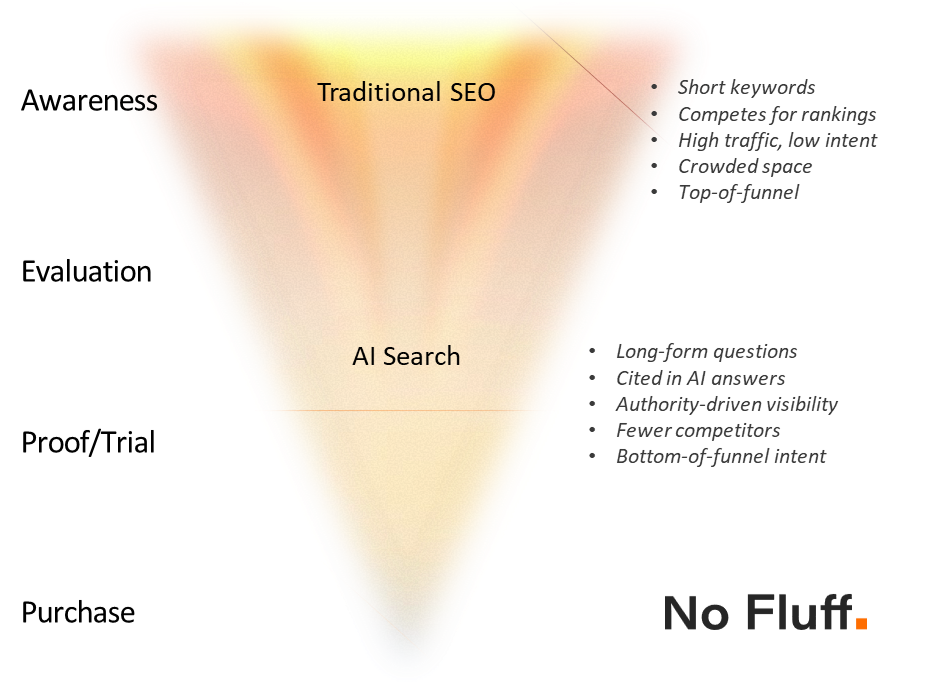
It also means that by the time buyers reach you, they already know who’s credible.
They’ve read what AI said about your pricing, your results, and your competitors, all without ever touching your site.
AI curates recommendations and rewards clarity, and the brands that make it to AI answers are the ones that have made themselves legible to the machines.
How to Build a Brand AI Can Recognize and Recommend
When a buyer asks a question, AI reconstructs a picture of your company using three layers of signals: structure, proof, and clarity. Miss one layer and you disappear. Here’s how that visibility is earned:
Step 1: Build a Structure Machines Can Read
AI engines first need to know who you are and what you do. That starts with technical clarity: your schema markup, consistent metadata, clean site structure, and clear entity reference. Here are some steps you can take:
- Use schema markup (JSON-LD). Define your company (Organization), people (Person), and services (Service). Tools like Google’s Rich Results Test or Schema.org templates make this easy to validate.
- Add an llms.txt file. Place it at the root of your domain to guide AI crawlers in plain language. Describe your company in one sentence, list core services, and link to authoritative pages.
- Keep everything crawlable. No PDFs for core content. No vague “solutions” pages. Text matters more than visuals in AI comprehension.
- Stay consistent across platforms. Your company name, tagline, and descriptions should match on LinkedIn, Crunchbase, directories, and press releases.
Structured data is what turns your website into something machines can actually understand. It tells AI who you are, what you offer, and how it all connects.
The brands that show up in AI-generated answers are the ones that have made themselves readable. When your structure is clear, AI can pull data straight from your site.
Step 2: Build Proof That Others Trust You
Next, it checks who else trusts you. Your credibility layer tells it that you’re not just claiming expertise; others agree you have it.
- Earn citations from industry publications or collaborate on research that is publicly referenced.
- Leverage existing networks, such as directory listings, analyst reports, and customer case studies.
- Use PR strategically. Get press mentions, podcasts, and credible interviews.
The more trusted domains that mention you, the faster AI connects your brand with reliability.
Step 3: Create Content AI Can Quote
Finally, AI tests whether it can explain you and your expertise. It pulls from case studies, FAQs, and articles that answer real buyer questions in plain language. Write with that in mind:
- Lead with answers and a clear statement of fact.
- Include data and outcomes, not claims.
- Use FAQs and How-To sections.
- Publish regularly in plain, factual language.
- Cite external sources and verified research.
Strong content gives AI something to explain. It also determines whether you’re quoted, skipped, or misrepresented.
TL;DR: The New Playbook for Building a Visibility Stack
Most B2B companies are still structured for a world where Google rankings defined awareness. To show up, your brand needs a connected visibility stack that aligns what you say, what others say, and what machines can understand.
| Layer | What It Does | Who Traditionally Owned It | Example Signals |
| Structure | Defines your brand in machine-readable terms | Web, Digital, SEO Teams | JSON-LD schema, llms.txt, consistent entity names |
| Proof | Builds external validation through credible mentions | PR & Leadership | Analyst quotes, backlinks, media features |
| Clarity | Gives AI something worth citing | Content & Product Marketing | FAQs, use-case articles, measurable outcomes |
| Measurement | Tracks how AI systems describe you | Analytics & Ops | AI citation audits, prompt-based benchmarks |
Each layer reinforces the next. Structure earns recognition. Proof earns trust. Clarity earns citations. Measurement keeps the loop improving.
The Clock Is Ticking
Here’s the uncomfortable math. Every month you delay, your competitors are training AI models to recommend them. These systems can only be learned through repetition. Once ChatGPT, Gemini, or Perplexity recognizes a brand as a default answer, changing that perception can take months of new data, citations, and PR reinforcement.
This isn’t another marketing trend. It’s the rewiring of discovery itself. The next twelve months can decide who defines your category inside AI systems and who disappears from them.
The new growth math is simple:
- Structured clarity beats keyword density.
- Credibility beats campaigns.
- Visibility beats volume.
Your next buyer is already talking to an AI. The only question left is whether that conversation includes your name.
Why a Unified System Matters
Most teams treat these layers as separate functions. SEO owns structure. PR owns proof. Content owns clarity. Ops owns measurement. Each team works hard, but the signals never converge and AI engines never get a complete picture of the brand. We replace scattered vendors and disconnected tools with one accountable system built for AI visibility. One team, one approach, one 90-day program that aligns every signal AI engines use to find, understand, and cite your brand.


