

Key Insights
- Invisibility isn’t traffic; it’s recognition. Buyers ask ChatGPT/Gemini instead of browsing.
- Brands get cited when AI can understand (structure), validate (trust), and explain (quotable content).
- Build recognition with schema, crawlability, internal linking, earn trust with credible third-party mentions, and publish plain-English answers and structured formats.
- Track AI mention and citation rate, not just pageviews.
What is “AI Recognition”? AI recognition means your brand is consistently named, described correctly, and cited in AI-generated answers. That happens when your site is machine-readable, your authority signals are verifiable, and your content is easy to summarize.
Why AI Answers Became the New Front Door to B2B Revenue
If you had a problem, you could search on Google, click through a few results, and perhaps download a form. But today, that has shifted significantly. Now people start with ChatGPT, Gemini, or perplexity. In a nutshell, people are no longer browsing; they are asking.
Digital Commerce 360 reports that over half of tech buyers (56%) now use chatbots or generative AI tools for vendor discovery. They ask questions like:
“Who are the top supply chain risk firms in the US?”
“What’s the best enterprise cybersecurity software for 2025?”
Traditional top-of-funnel tactics like SEO, gated content, and funnels are slowly losing their visibility power. In plain terms, the front door of your brand is now an AI tool, not your homepage. The brands that show up first are the ones AI can understand, verify, and explain clearly.
What Generative Engines Actually “See”
You might say: our website is still doing well, and our campaigns are still generating leads. But are you being seen where it really counts?
We’ve discovered that many brands are invisible to the machine readers behind the AI because they treat their brands as if they are targeting Google visibility and hoping to land on AI mentions.
AI systems crawl the web differently from Google. Instead of looking for keyword stuffing and ad budgets, they are checking whether your brand is machine-readable and human-trustworthy. How do LLMs source and cite info? Generative engines draw on trained datasets, knowledge graphs, and trusted signals. They need to see: “Who are you?” “Do we trust you?” “Can we quote you?” If you tick these boxes, welcome to AI visibility.
No Fluff’s AI Visibility Methodology
To be cited by AI, your visibility must be built across three connected layers (with input from measurement analysis, which we will talk about below). Each belongs to a real operational role in your company.
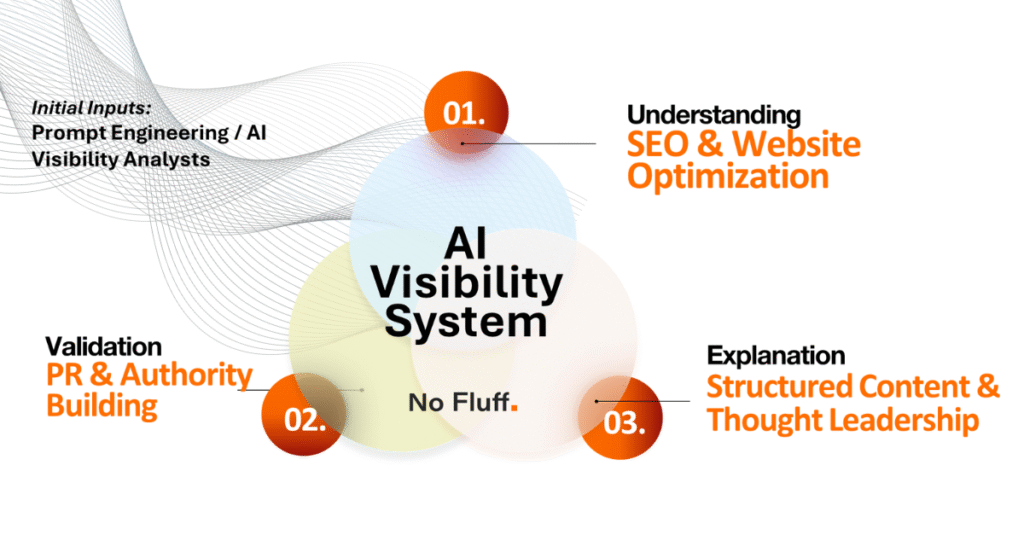
1. Understanding: Making AI Recognize Who You Are
If there is one piece of advice we could give any B2B leader, it would be to make their brands recognizable by machines. This falls to your technical SEO and web teams. If AI can’t understand your structure, it can’t cite your brand. In practice, this means:
- Use of robust schema markup, metadata that clearly identifies our business, expertise, and products.
- Internal linking across related topics so the AI builds a coherent story of your domain expertise rather than dozens of disconnected pages.
- A fully crawlable site: no buried content behind gated PDFs, no text hidden in images, no ambiguous landing pages. If the AI can’t read it, it can’t reference it.
Search Engine Journal (2025) notes that structured data increases a site’s AI visibility by helping engines understand context, not just content. In short, SEO is no longer just about keywords and links; it’s about building a machine-readable brand.
2. Validation: Earning AI’s Trust
Once the machine “knows” who you are, it asks: “Are you credible?” That’s the job of your PR, corporate communications, and leadership teams. This proof comes from your external footprint, such as features, mentions, and quotes on trusted domains. Research from eMarketer shows that brand trust rises by up to 85% when companies appear in high-quality, credible media environments, compared with lower-quality or purely promotional placements. The same principle applies to AI.
Hence, your campaigns must shift from pushing traffic to generating authority signals like real mentions in places the machine already trusts.
Also, don’t downplay entity consistency. Ensure that details such as your company description, leadership bios, and contact data are consistent across all platforms. Even small mismatches (like different job titles or service names) can break your authority graph and cause AI to skip you.
3. Explanation: Giving AI Something Worth Repeating
This is where you deliver content the machine can use. Here, your research and product teams work in sync with the content and product marketing to produce material that AI tools can quote or summarize.
That means:
- Answering real buyer questions in plain English.
- Using structured formats like FAQs, guides, and comparison tables.
- Publishing original insights or data that AI can cite confidently.
Brands that treat content like “what the buyer will ask the bot next” win far more visibility than those writing “what we want to rank for.” In other words: talk to the AI, not just to Google.
Measuring Recognition: Turning Recognition Into Evidence
Visibility in generative search can be measured, not guessed. Here is where your analytics and leadership come into play by tracking what’s vital. Instead of tracking traffic, bounce rates, and conversions, they now start tracking whether AI recognizes or recommends you.
KPIs that Matter:
- Mentions and citations inside generative AI platforms.
- Which pages or assets do the AI tools reference?
- Growth in mentions across trusted domains.
Traditional vanity metrics still have their place, but if the machine doesn’t cite you, all the traffic in the world doesn’t matter for those early-stage buyers. So shift your KPI focus from “page views” to “AI citation rate” and watch your visibility increase.
The Leadership Lesson
As B2B leaders, let’s face it: we can’t buy recognition in generative search. We earn it. Machines don’t care about our budget; they care about our proof. They don’t reward clever campaigns; they reward connected credibility.
In essence, you can’t engineer recognition without proof. And for B2B firms, this means aligning SEO, PR, and content around one shared outcome: to be findable, quotable, and trusted in AI answers.
This goes beyond improving your marketing efforts. It’s more about connecting what you already do. We are already in a period when the first ‘visit’ happens inside an AI tool. Being seen once is good, but being cited? That’s how we win the shortlist. Let’s make sure that when someone asks AI a question in your category, your brand’s name is in the answer.
FAQs
How is AI recognition different from SEO rankings?
AI recognition is about whether a generative system can identify, trust, and cite your brand in answers. SEO rankings focus on page position and clicks, while AI recognition focuses on explanation and attribution.
What makes a brand “citable” in AI answers?
Citable brands have a clear machine-readable structure, consistent identity signals, third-party credibility, and content written in plain language that directly answers real buyer questions.
Can paid ads or a budget increase AI visibility?
No. Generative AI systems do not factor ad spend into citations. They prioritize structured understanding, trust signals, and authoritative explanations.
How do you measure AI visibility if traffic declines?
By tracking mentions, citations, and references inside generative AI platforms and across trusted third-party sources, rather than relying solely on traffic or conversion metrics.


