

Buyers now ask AI systems like ChatGPT, Gemini, and Perplexity to explain categories, compare options, and recommend vendors. Those answers are shaped by structure, authority, and clarity, not marketing polish.
This 64-Point AI Visibility Checklist answers one question: if an AI system had to explain your business to a buyer today, do you have the right signals in place for it to get it right? This is not a content to-do list, but a visibility control system. Each checkpoint maps to how modern AI systems:
- Access your site
- Interpret what you do
- Evaluate credibility
- Decide whether to cite and recommend you
Who is it for?
B2B, professional services, and complex buying cycles where trust and proof matter more than clicks. If you sell to committees, operate in regulated spaces, or rely on expertise, you need consistent signals that AI can parse and reuse.
By following this checklist, your company will:
- Become findable in AI answers for your category, problems, and use cases
- Reduce misinterpretation of your offers, pricing, and proof
- Increase citations from trusted third-party sources AI leans on
- Strengthen the data structures AI uses to summarize your page
How the checklist is structured
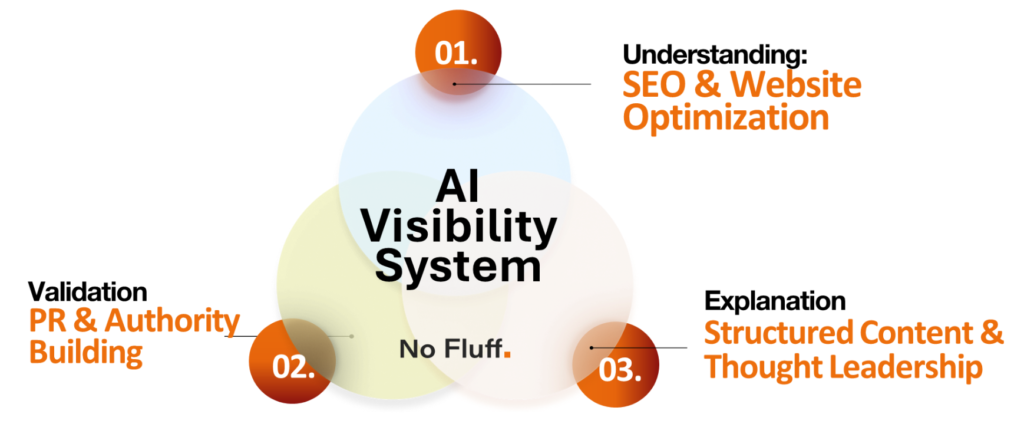
The 64 checkpoints are grouped into four sections: Understanding (SEO & Website Optimization), Validation (PR & Authority), and Explanation (Structured Content & Thought Leadership). Each section reflects a decision layer used by AI systems when assembling an answer. AI does not “rank” as traditional search does. It looks for confidence built from structure, corroboration, and clarity.
Each checkpoint includes:
- Checkpoint: the specific action or asset to verify
- Why it matters: the AI behavior it supports
- Requirement: the minimum standard to meet before you can move on to the next checkpoint
How to use it
Before running a checklist like this, leadership teams should first decide which prompts they want to win. AI visibility is not about “optimizing everything.” Identify the specific questions buyers ask where you want to be cited, recommended, or compared. When those core prompts are defined upfront, the audit becomes focused, messaging tightens, and structural decisions align around a clear outcome instead of scattered improvements.
After that, you can work section by section. Fix the structural gaps first, then authority gaps, then coverage gaps. But be cautious. Authority is the slowest lever to move. Third-party mentions require outreach, follow-ups, meetings, drafts, edits, and waiting on someone else’s timeline. If you wait to think about authority until after everything else is “perfect,” you’ll delay the one signal that takes the longest to compound.
Treat this as an ongoing control system you can audit quarterly, not a one-time project. The goal is simple: make your business easy for AI to understand, easy to trust, and safe to recommend.
Section 1: AI Understanding (SEO & Website Optimization)
AI must clearly understand who you are, what you offer, and the problems you solve. That depends on clean structure, consistent naming, and machine-readable signals. This section focuses on making your site accessible and interpretable so systems can accurately map your entity, offerings, audience, and content hierarchy. Without that foundation, even strong authority signals can be misread or overlooked.
| Checkpoint | Why | Requirement |
| 1) Site Speed | Fast-loading pages enable more efficient crawling | Server response time <600ms on core pages |
| 2) Core Web Vitals | AI models use your page load time, render delay, interaction latency, and network stability to ensure your page is legit | LCP <2.5s INP <200ms CLS <0.1 on mobile & desktop |
| 3) Server-Side Rendering or Static HTML | Responsive design, touch-friendly UI readable text without zoom | Critical content (headings body text tables) visible in View Source without JavaScript |
| 4) Mobile- First Optimization | AI platforms prioritize mobile-friendly content | AI bots (GPTBot ChatGPT-User Claude-Web Google-Extended) are not blocked from priority content |
| 5) Robots.txt – AI Crawler Access | This approach balances traditional SEO with AI visibility | Organization schema on homepage with name logo, sameAs links contact info |
| 6) LLMs.txt Implementation | Provides AI systems with acurated roadmap of your most important content. | /llms.txt file exists at the site root and points to key pages |
| 7) Organization Schema | Anchors your brand identity and gives AI systems structured data to consistently reference your brand. | Blog posts include Article schema with author, datePublished dateModified |
| 8) Article Schema (B2B/Saas Priority) | Clarifies and verifies content type, author, publication date, and topic | Blog posts include Article schema with author, datePublished, dateModified |
| 9) Product/Service (B2B/Saas Priority) | Clear product and service pages help AI understand what you offer and when to recommend you. | Author/team pages include Person schema with name, jobTitle sameAs image |
| 10) HowTo Schema | Maps to step-by-step instructions that AI systems use for procedural queries | How-to/tutorial content includes HowTo schema with defined steps |
| 11) Person Schema | Defines structured details about authors or contributors | Key industry terms/concepts link to Wikipedia, Wikidata or authoritative sources where appropriate |
| 12) Breadcrumb Schema | Strengthens site navigation and content hierarchy. | BreadcrumbList schema on non-homepage pages |
| 13) Internal Entity Linking | Connects entities within your text content to corresponding entities in your Content Knowledge Graph | Product mentions link to Product pages; person names link to bios; company mentions link to About |
| 14) External Entity Linking | Connects entities to unique identifiers from external authoritative knowledge bases. | Key industry terms/concepts link to Wikipedia, Wikidata, or authoritative sources where appropriate |
| 15) AI-Optimized Metadata | Provides explicit context that helps AI systems match content to user needs | Meta descriptions 120-155 chars; title tags include target keywords |
| 16) Hub-and-Spoke Content Architecture | Organize content into topic clusters with a central pillar page linking to support subtopic pages | Pillar pages exist for core topics; subtopic pages link to pillar and vice versa |
| 17) Contextual Anchor Text | Use keyword rich anchor text that tells AI systems which keywords and pages to rank for | Internal links use descriptive keyword-rich anchor text (not click here or read more) |
| 18) Link Equity Distribution | Pages with more internal links pointing to them are viewed as more important and rank higher | Most important pages (product pillar content) have highest number of internal links |
| 19) NAP Consistency – Website (if Location-Based Only) | Inconsistent Name, Address, or Phone (NAP) creates entity ambiguity and weakens local inclusion and citation confidence. | Display identical NAP across header, footer, contact page, and location pages |
| 20) NAP Consistency – External (if Location-Based Only) | Conflicting listings reduce trust signals and may cause omission from local recommendations. | Google Business Profile matches website NAP exactly (Check Yelp, LinkedIn, etc and industry directories) |
| 21) LocalBusiness Schema (if Location-Based Only) | Strengthens location validation, improves AI understanding, and reduces misattribution. | LocalBusiness (or subtype) schema |
Section 2: AI Validation (PR & Authority Building)
AI looks for third-party validation to confirm credibility. Without it, a brand may be recognized but not referenced. Systems rely on corroboration across the web, including authoritative backlinks, media mentions, reviews, expert authorship, and consistent entity signals. This layer determines whether your brand is trusted enough to be cited in high-stakes responses.
| Checkpoint | Why | Requirement |
| 22) Authoritative Backlinks – Quality | High-authority backlinks increase domain credibility thresholds that AI systems use when selecting citation sources. | Domain Authority/Authority Score >40; backlinks from DR 60+ domains |
| 23) Authoritative Backlinks – Relevance (B2B/SaaS Priority) | Topically relevant backlinks strengthen entity association within your industry, increasing citation likelihood for category queries. | At least 50% of backlinks from topically relevant sites (industry publications related businesses) |
| 24) Backlink Diversity | A diverse referring domain profile signals broad third-party validation rather than isolated endorsement. | Backlinks from 50+ unique referring domains |
| 25) Third-Party Media Mentions (B2B/SaaS Priority) | Mentions in respected publications act as external corroboration that AI systems rely on to validate brand legitimacy | Mentioned in 10+ high-authority publications (industry media major news analyst reports) in past 12 months |
| 26) Unlinked Brand Mentions | AI models recognize entity mentions even without links, strengthening brand recognition in knowledge graphs | Brand mentioned (even without link) on 25+ external authoritative sites |
| 27) Expert Source Appearances | Being quoted as an expert increases authority signals tied to your brand entity. | Company executives quoted/featured in 5+ external articles in past 6 months |
| 28) Published Case Studies | Structured case studies provide verifiable proof that supports recommendation confidence. | Minimum 3 detailed case studies with customer name challenge solution quantified |
| 29) Case Study Metrics | Quantified outcomes increase AI confidence because measurable results reduce ambiguity. | Each case study includes at least 2 specific metrics (% increase $ saved time |
| 30) Review Platform Presence | Third-party review platforms serve as independent validation layers AI frequently cites. | Active profiles on G2 Capterra TrustRadius or relevant review platforms with 20+ reviews |
| 31) Average Review Rating | High aggregate ratings act as trust shortcuts in AI-generated recommendations. | 4.0+ star average across review platforms |
| 32) Review Schema Implementation | Structured review markup makes credibility signals machine-readable and extractable. | AggregateRating schema on product/service pages if you have reviews |
| 33) Testimonials on Website | Direct customer validation reinforces trust signals when AI cross-checks claims. | At least 10 customer testimonials visible with customer name/company |
| 34) Author Bios – Completeness | Detailed bios strengthen E-E-A-T (Experience, Expertise, Authoritativeness, Trustworthiness) signals by clearly defining expertise. | All authors have bio pages with credentials expertise areas photo contact/social |
| 35) Author Bios – Person Schema | Person schema converts expertise into machine-readable authority signals. | All author bios include Person schema with jobTitle worksFor knowsAbout sameAs |
| 36) LinkedIn Presence | Verified professional presence supports entity legitimacy across platforms. | Company LinkedIn page with 500+ followers; key executives with complete prof |
| 37) Social Verification | Consistent branded social profiles reinforce entity consistency in knowledge graphs. | Brand present and active on 2+ relevant platforms (LinkedIn Twitter/X YouTube etc.) |
| 38) Cross-Platform Linking | Linking owned properties together strengthens entity consolidation and reduces ambiguity. | Organization schema includes sameAs links to verified social profiles |
| 39) Industry Recognition | Awards and recognitions act as third-party validation signals AI may reference. | Awards certifications or analyst recognition (Gartner Forrester industry awards) in past 2 years |
| 40) Partnership/Integration Badges | Recognized partnerships transfer trust through association with established entities. | Official partner badges from major platforms displayed on website if applicable |
| 41) Original Research (B2B/SaaS Priority) | Publishing proprietary data increases citation likelihood because AI favors unique, sourceable insights | Published at least 1 original research report survey or proprietary data study in past 12 months |
| 42) Proprietary Frameworks | Clearly defined methodologies create distinct entity markers AI can associate with your brand. | Documented proprietary methodologies frameworks or processes unique to your brand |
Section 3: Explanation (Structured Content and Thought Leadership)
AI relies on structured, reusable content to generate clear explanations of your differentiation and fit for specific use cases. Without it, systems default to explaining the category instead of your unique value. Strong positioning, comparison pages, FAQs, use-case content, and measurable proof points create the explanatory depth needed to extract, summarize, and confidently recommend your brand.
| Checkpoint | Why | Requirement |
| 43) Core Page Text Rendering | AI crawlers cannot interpret hidden or JavaScript-only content, so rendered HTML ensures accessibility. | Homepage About Product pages have all critical info in rendered HTML text (not only images/video) |
| 44) Tables for Comparison | Tabular data reduces ambiguity and improves structured extraction accuracy. | Comparison/feature data presented in HTML tables (not just images) |
| 45) Answer-First Structure | Leading with conclusions helps AI extract primary meaning even if it doesn’t parse full context. | Core pages lead with conclusion/key point in first 1-2 sentences; supporting details follow |
| 46) Descriptive H2/H3 Headings | Query-matched headings signal topical relevance and improve semantic alignment. | Headings describe content (not generic Overview); match likely user queries |
| 47) Heading Hierarchy | Proper hierarchy clarifies content relationships for structured interpretation. | Proper H1 > H2 > H3 structure with no skipped levels |
| 48) Paragraph Length | Short paragraphs improve parsing clarity and reduce semantic dilution. | 80%+ of paragraphs are 2-4 sentences; each conveys single main idea |
| 49) Dedicated FAQ Pages | Standalone FAQ hubs increase eligibility for conversational query citations. | Standalone FAQ page exists; each product/service also has FAQ section |
| 50) FAQ Breadth | Broad question coverage expands prompt match probability across varied user phrasing. | FAQ content covers at least 20 common customer questions across product pricing implementation support |
| 51) FAQ Schema Implementation | FAQ schema feeds structured Q&A directly into AI systems. | All FAQ content marked up with FAQPage schema; Q&A pairs match visible content exactly |
| 52) Question-Based Optimization | Matching real user phrasing increases retrieval relevance in AI prompts. | Dedicated pages or FAQ questions phrased the way customers actually ask (conversational natural language) |
| 53) How-To Content Volume | Procedural content is frequently cited in AI-generated instructional responses. | At least 5-10 published how-to guides/tutorials related to your product or category |
| 54) Step Structure | Numbered steps align with how AI surfaces structured instructional answers. | Instructional content uses numbered steps with clear headings |
| 55) Use Case Content | Context-specific pages help AI match your solution to user intent. | At least 3-5 detailed use case pages for different customer segments/scenarios |
| 56) Comparison Content | “Vs.” content clarifies competitive positioning and improves inclusion in AI-generated lists. | Vs. [competitor] and alternative to [competitor] pages exist for top 3-5 competitors |
| 57) Differentiation Clarity (B2B/SaaS Priority) | Explicit differentiation reduces AI ambiguity when summarizing alternatives. | Core pages explicitly state how you differ from alternatives (clear differentiation statement) |
| 58) Content Freshness | Updated timestamps signal current relevance in real-time retrieval systems. | 80%+ of core pages updated in past 12 months (visible dateModified in schema or on page) |
| 59) Evergreen Content Refresh | Regular updates maintain citation eligibility as models favor recent data. | Glossary how-to guides FAQ pages refreshed with new data/examples every 6 months |
| 60) About Page Completeness | A comprehensive about page anchors brand identity in entity databases. | About page includes mission founding story leadership team key milestones differentiators |
| 61) About Page Structure | Structured narrative improves extractability for branded queries. | About page uses clear H2 headings; critical info in rendered text (not buried in toggles/accordions) |
| 62) Leadership/Team Pages | Public executive pages increase entity legitimacy and reduce “anonymous brand” risk. | Dedicated Leadership or Team page |
| 63) Team Member Details | Detailed bios help AI evaluate expertise and credibility at the person level, not just the brand level. | Detailed bios for key team members, including experience, credentials, achievements, and implement the Person schema. |
| 64) Team Expertise Clarity | If leadership bios do not explicitly reference domain expertise tied to what you sell, the authority signal weakens. | Explicitly connect each person’s domain expertise to the company’s core services and product promise |
Measuring Brand Visibility in AI-Generated Answers
AI visibility is not a one-time optimization project. It becomes real when it is measured consistently against the same buyer questions, tracked over time, compared against competitors, and tied to actual traffic impact. The structural work you have done, improving clarity, strengthening content, cleaning up technical foundations, and earning validation, only compounds if you can see what is working and adjust accordingly. Measurement turns visibility from a theory into a managed growth channel.
- Establish a fixed set of real buyer questions to test repeatedly
- Capture a clear baseline of mentions, positioning, and competitors
- Re-run consistently to detect gains, losses, and shifts
- Track trends over time, not just one-off snapshots
- Attribute traffic from key platforms to measure business impact
Visibility Is a System, Not a Tactic
Becoming visible in AI search is not the result of a single tactic. It is the outcome of a system that compounds over time. In a search environment where AI responses cite only a handful of sources, visibility is earned through clarity, corroboration, and confidence signals, not volume. This checklist provides a systematic approach to move from invisible to citable by aligning your technical foundation, external validation, structured content, and measurement discipline with how AI systems actually work. Execute it fully, measure relentlessly, and refine continuously. The brands that do will not just appear in AI search; they will be the ones recommended.
FAQs
What is AI visibility?
AI visibility is how often and how accurately your brand appears in AI-generated responses across platforms like ChatGPT, Gemini, Perplexity, and Google AI Overviews.
How is AI visibility different from traditional SEO?
Traditional SEO focuses on rankings and clicks, while AI visibility focuses on being cited, summarized, and recommended inside AI answers that typically reference only a few sources.
Why do some brands get cited in AI responses and others do not?
AI systems prioritize brands that are structurally clear, externally validated, and supported by authoritative signals such as backlinks, media mentions, reviews, and expert authorship.
What type of content gets cited most often by AI?
AI most frequently cites structured content such as FAQs, how-to guides, use-case pages, comparison content, and pages that clearly state differentiation with measurable evidence.
How do you measure AI visibility?
AI visibility is measured through citation frequency, AI share of voice, position within AI-generated lists, sentiment analysis, and AI-referred traffic tracked in analytics platforms.


