

Key Takeaways:
- AI visibility is driven by authority consolidation, not content scale. Generative engines cite a limited number of sources, so focus beats volume.
- Winning decision prompts requires upstream influence. You must build trust in Awareness, Consideration, and Validation before AI will recommend you.
- High-leverage prompts create the fastest momentum. Prioritize areas where citation weight and source consolidation are still low.
- AI visibility compounds over time. Repeated citation in a narrow domain increases trust, expands influence, and eventually drives recommendation.
AI Visibility Is a Focus Problem, Not a Scale Problem
In the traditional SEO era, B2B marketers were taught that more content equaled more visibility. The shift to generative search has killed that scale instinct. In an AI ecosystem, visibility does not improve evenly across the web; it compounds fastest where AI trust is still undecided.
Because generative engines are citation-limited, they do not reward volume. They reward authoritative consolidation. Trying to show up for every possible prompt is a recipe for invisibility. To win, you must stop treating AI search like a ranking race and start treating it as a prioritization problem.
The AI Prompt Hierarchy: Awareness, Consideration, Validation, Decision
B2B buyers interact with AI through four distinct stages. Understanding the dynamics of each stage is the first step in deciding where to allocate your resources.
1. Awareness: Defining the Category
These are the “What is” questions. Users are looking for definition, category education, and problem framing.
- AI Dynamics: These prompts typically have low competition and a very high citation likelihood. AI models rarely name vendors here by design, instead pulling from 1–3 primary sources repeatedly.
- Why It Matters: These prompts define the category and teach the AI model your specific terminology and framing. If you do not own the awareness layer, winning decision-level prompts later becomes significantly harder.
2. Consideration: Shaping the Solution
These prompts focus on solution approaches and “how-to” methods.
- AI Dynamics: This stage has medium competition and high citation density. While vendor naming is often indirect, this is the highest ROI stage for new authority brands.
- Why It Matters: This is the fastest path to momentum because it primes the AI to trust your framework, converting general awareness into a specific preference for your methodology.
3. Validation: De-Risking the Choice
Validation prompts are used by skeptical buyers to check accuracy, metrics, and credibility.
- AI Dynamics: These prompts have low competition and high trust weighting, where the AI favors verifiable citations over general opinions.
- Why It Matters: This stage separates execution-led firms from the hype. It accelerates trust by providing the proof AI needs to move from “citing you” to “recommending you”.
4. Decision: Capturing Demand
These are the “Best of” and “Top vendor” rankings.
- AI Dynamics: Competition is at its highest here. AI relies heavily on third-party mentions and prior citations to formulate its list.
- Why It Matters: Decision prompts are a lagging indicator, not a starting point. If you haven’t built authority upstream in awareness and consideration, you cannot win these prompts through your website alone.
AI Visibility Metrics: How to Prioritize the Right Prompts
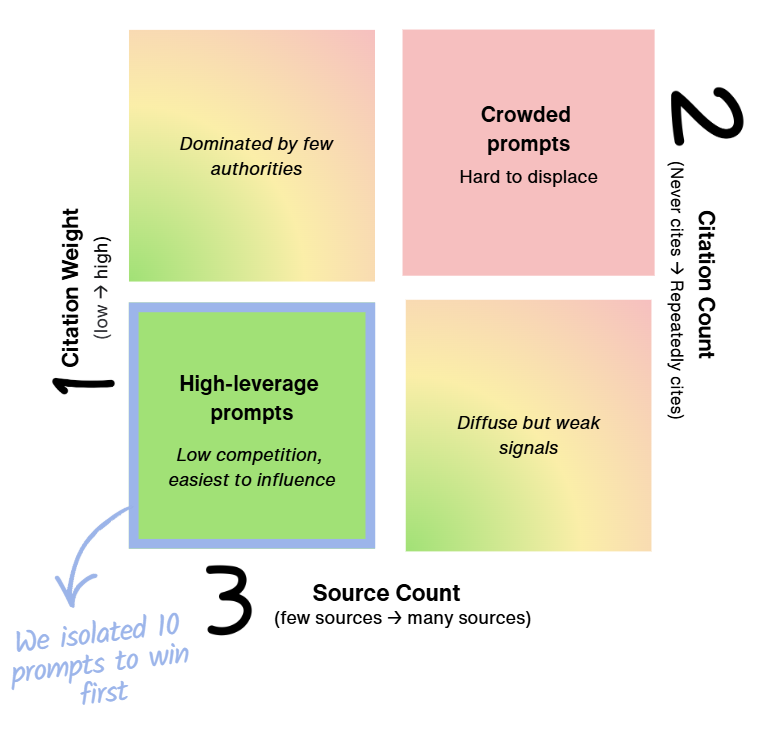
Even within the right categories, you cannot chase every prompt. We use three core metrics to reveal where focus actually pays off:
- Citation Count: The number of times a specific source is cited for a prompt. This measures the strength of AI trust in that source relative to others.
- Total Citation Weight: The sum of all citation counts across all sources. A high weight indicates a crowded and consolidated knowledge space that is hard to displace.
- Unique Source Count: The number of distinct domains the AI references. A low count suggests the AI relies on a few entrenched authorities, while a high count indicates a fragmented landscape ripe for influence.
High-Leverage Prompts: Where AI Trust is Still Undecided
The goal is to find High-Leverage Prompts—those with low citation weight and a low unique source count. These represent areas where there is conceptual ambiguity or weak sourcing. In these “green zones,” you have the greatest opportunity to define the narrative and become the AI’s primary source with the least amount of effort.
Conversely, you should deprioritize prompts that are already dominated by a single, entrenched authority or those with low buyer intent. Unless you are building an entirely new category, generic awareness prompts are often just noise.
AI Visibility Compounds Through Consolidation
AI visibility is cumulative. You are not competing with the whole internet; you are competing for space in a very small citation pool. By narrowing your focus to prompts where AI trust is still undecided, you can teach the models who you are and why your framework matters.
Once you consolidate trust in these high-leverage areas, the AI will naturally begin to reference your framework and, eventually, name you as a leader. Consolidation is the only path to expansion.
FAQs:
1. Why doesn’t publishing more content improve AI visibility?
Generative search engines are citation-constrained. They reference a small pool of trusted sources per prompt. Publishing more content only works if it consolidates authority within a defined prompt cluster; otherwise, it dilutes impact.
2. What makes a prompt “high-leverage” in generative search?
A high-leverage prompt typically has low total citation weight and a low unique source count. This indicates that AI trust is not yet consolidated, creating an opportunity to become the primary cited authority with focused effort.
3. Why are decision-stage prompts like “best [category] software” so difficult to win?
Decision prompts are a lagging indicator of authority. AI models generate vendor lists based on prior citation history and third-party validation. Without upstream authority in Awareness and Consideration, you are unlikely to appear in recommendations.
4. How does AI determine which sources to cite?
AI systems prioritize sources that demonstrate:
- Consistent topical authority
- Repeated citation patterns
- Verifiable validation signals
- Clear conceptual ownership of a framework or methodology
Trust consolidation outweighs publication frequency.
5. What is the most effective starting point for building AI visibility?
Begin in the Consideration and Validation stages, where citation density is meaningful but competition is not yet entrenched. Focus on owning a narrowly defined conceptual territory, then expand outward once trust is established.


