

Welcome to Week 7 of No Fluff’s Zero-to-Visible in AI 90-Day Experiment.
If you’re new here, this is a live test we launched on December 11th to answer a simple question: “Can a brand that didn’t exist yesterday become visible inside AI answers in 90 days?” We’re officially at the halfway point.
We have successfully moved from zero to real organic visibility and a measurable AI presence. But there is still much room for us to grow.
The Halfway Metrics
For a brand-new site with no existing audience, no paid media, and almost no backlinks, in 49ish days, we have generated 5,000 impressions in Google search with an average rank position of 2.6. This timeline is notably faster than the industry standard, where most new websites require three to six months for meaningful SEO traction and up to a year for strong rankings.
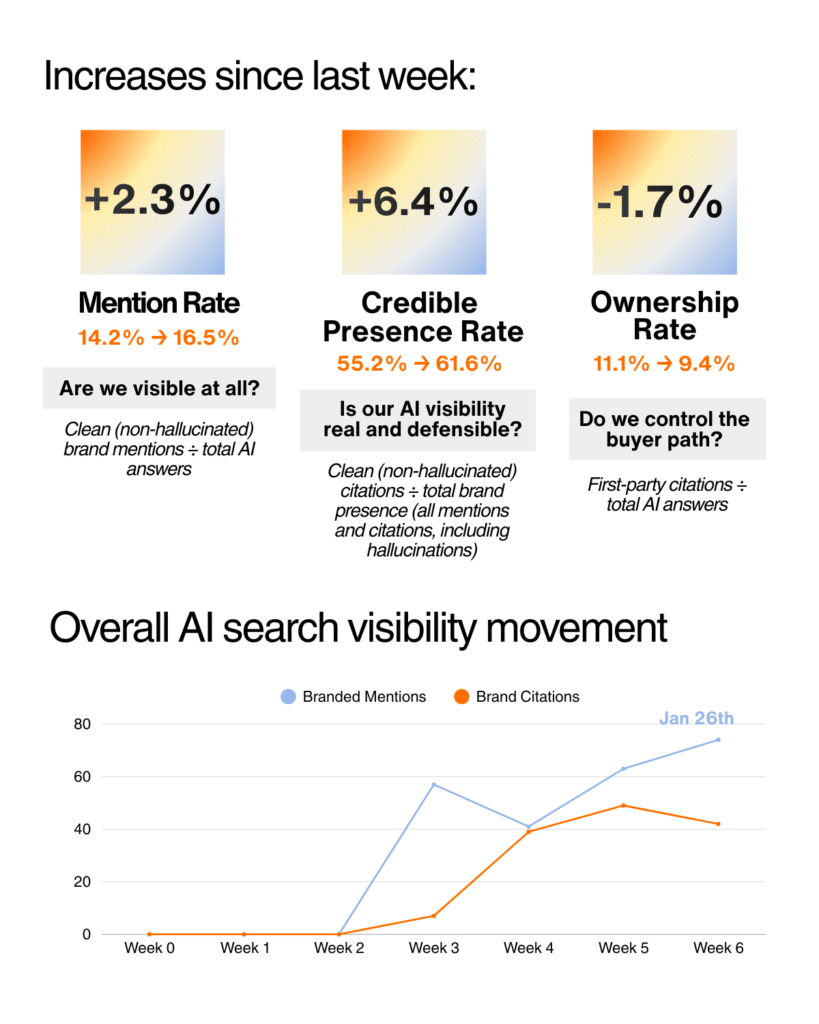
Our visibility across ChatGPT, Gemini, and Perplexity is also registering. We have recorded 74 total brand mentions and 42 credible citations in AI answers. These consistent citations in under 60 days indicate that AI engines can identify our brand and are beginning to trust our signals.
Weekly Performance and Actions, Overall six-week AI visibility movement
This week saw several shifts in our visibility data. Our Mention & Credible Presence Rates are trending upward. While our Ownership Rate was slightly down, with a small margin of error.
Weekly Performance and Actions
This week saw several shifts in our visibility data. Our Mention & Credible Presence Rates are trending upward. While our Ownership Rate was slightly down, with a small margin of error.
To drive these results, our work focused on three strategic areas:
- We released deep comparison content, specifically “best of” style pages designed as honest, criteria-driven evaluations rather than self-promotional lists
- We treated PR as a tool for signal alignment rather than just exposure, conducting deep research into media outlets and connecting with partners that value our learnings and data.
- We performed technical updates by resubmitting our sitemap to Google and updating our LLMS.txt files.
Strategic Takeaways and Insights
The most significant lesson this week is that AI-generated answers are the ultimate marketing stress test. Because AI synthesizes your entire digital footprint, including your website, reviews, and third-party coverage, an AI search analysis reveals the fundamental cracks in your marketing foundation.
Across three very different client snapshot audits, we uncovered distinct gaps in how AI interprets each business:
- A growing SaaS product: AI could describe the category, but struggled to clearly explain what made the product different.
- The fix: Make the difference obvious using real comparisons, third-party proof, and clear reasons to choose it.
- A local services shop: AI was confused because the business lived across two different websites.
- The fix: Consolidate reviews and proof in one place, and reference the location in nearly every entry.
- A niche consumer product: AI recognized the product, but didn’t include it in answers that help buyers understand fit, value, or tradeoffs.
- The fix: Reinforce material quality, durability, performance, and credible comparisons to reduce buyer hesitation.
Our final lesson is that not every prompt (buyer question) needs to “name” your brand in the answer to be a win. For early-stage educational questions, the objective is to be the “cited explanation.” If an AI pulls an answer from your content to explain a concept like the difference between GEO and SEO, you have won the authority battle, even if the brand name isn’t the primary focus.
That’s it for this week!
Stat of the Week
Google’s Gemini has surgured to over 20% of generative AI traffic (YahooTech)
AI search landscape is becoming more competitive every day and visibility across multiple engines now matters more than ever.
Fresh Reads
Each newsletter, we’ll share our favorite articles and breaking news.
- Who Are the Best GEO Partners for B2B SaaS, and How Do You Evaluate Them?
- Backlinks in the Age of AI: How B2B Brands Build Trust That Machines Recognize
- Google AI Overviews Cite YouTube more than any medical site for health queries (The Guardian)
- Yahoo Launches AI Answer Engine, Scout (Axios)
As always, reach out anytime at katie@nofluffmktg.com if you’ve got questions or if you’re building your own visibility story too.
Subscribe to our newsletter here
Frequently Asked Questions About Zero-to-Visible and No Fluff
What is the Zero-to-Visible experiment?
Zero-to-Visible is an ongoing experiment that documents how a new brand becomes discoverable, explainable, and citable by AI systems. It tracks which signals influence whether AI systems recognize and recommend a company during early buyer discovery.
What does “AI visibility” mean in Zero-to-Visible?
In Zero-to-Visible, AI visibility means whether AI systems can recognize a brand, accurately explain what it does, and include it in AI-generated answers when buyers ask category-level questions.
Who is running the Zero-to-Visible experiment?
The Zero-to-Visible experiment is run by No Fluff, a B2B growth firm focused on how AI systems recognize, explain, and recommend brands in AI-generated answers.
Why is No Fluff running this experiment publicly?
No Fluff runs Zero-to-Visible publicly to document real-world signals that influence AI visibility. The goal is to replace speculation about AI search with observable patterns and repeatable methods.
Are the results specific to one AI platform?
No. Zero-to-Visible observes patterns across multiple AI systems, including retrieval-based and generative models. While individual outputs vary, consistent signals tend to produce similar visibility outcomes across platforms.
Can other B2B brands replicate these results?
Yes. When the same structural signals—clear brand definitions, consistent category positioning, structured content, and third-party validation—are applied consistently, similar AI visibility patterns can be reproduced.
Does Zero-to-Visible replace SEO?
No. Zero-to-Visible shows how AI visibility builds on SEO foundations. SEO enables access to content, while Zero-to-Visible focuses on whether AI systems trust, explain, and recommend a brand once that access exists.


