

Welcome to Week 8 of the Zero-to-Visible in AI 90-Day Experiment.
If you’re new here, this is a live experiment we launched on December 11th to answer a very specific question:
Can a brand-new company (with no history, no press, and no backlinks) show up in AI-generated answers alongside established competitors?
This week’s update matters because it builds on what we’ve been tracking and sharpens our understanding of why certain content gets picked up and cited.
The Metrics: Signals Are Compounding
Across the board, visibility signals continued to improve:
- +3.5% Mention Rate (Answers: Are we visible at all in AI answers?) 16.5% → 20.0%
- +4.8% Credible Presence Rate (Answers: Is our AI visibility real and defensible [no hallucinations]?) 61.6% → 66.4%
- +3.6% Ownership Rate (Answers: Do we control the buyer path? First-party citations ÷ total AI answers) 9.4% → 13.0%
Overall seven-week AI visibility movement
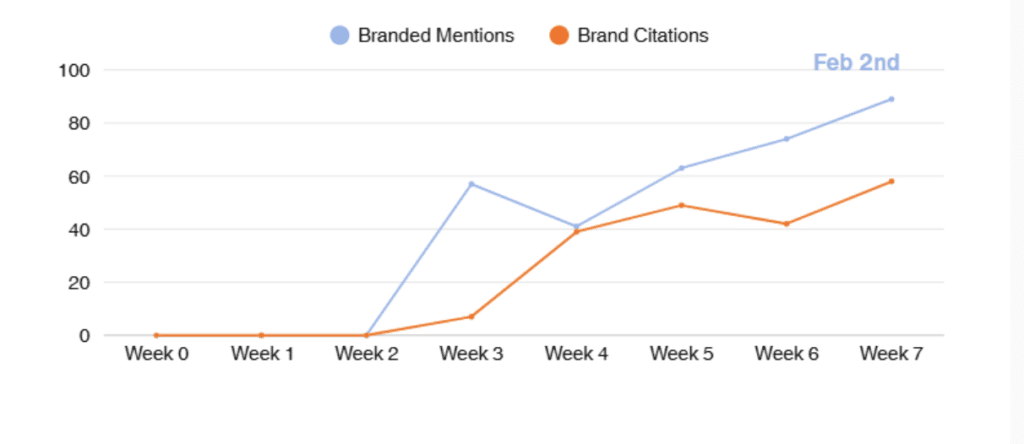
These shifts gave us enough signal confidence to stop watching totals and start studying causality.
What We Analyzed This Week
Rather than asking more than just “what went up,” we asked:
- What pages are AI systems actually pulling from our site?
- What content is being pulled from outside our site; LinkedIn, Medium, and other channels?
- What structural and distribution patterns are consistent across content that gets cited?
Here is what we learned:
- “Publishing” alone did not trigger AI pickup None of our top-performing pages were cited simply because they existed on our site. Pages were only picked up after the ideas were reinforced elsewhere, with clear links back to the source. Tip: Every important page needs at least three intentional external link-backs.Topic mattered far less than structure
- Topic mattered far less than structure Pages that performed well shared the same traits: Answer-first openings, numbered steps or clear sequencing, one focused idea per page. Content that wandered (even if it was thoughtful or “robust”) consistently lagged behind in AI pickup Tip: Write to be extractable, not impressive. Clarity beats completeness.
- AI pickup can happen in just a few weeks. We launched on December 11. By early January (around the 5th), AI systems had already indexed and started citing our site, and they’ve continued to pick up new pages since. That’s a 2–3 week window, not a long-term waiting game. Tip: You don’t need tons of content. Clean structure (schema, llms.txt, and clear entity definition) is often enough to trigger early AI pickup.
- However, the strongest amplifier wasn’t our website LinkedIn posts were picked up before the corresponding pages on our site. AI is more likely to draw from sources it already trusts and knows. Tip: Publish key ideas first on high-authority platforms (like LinkedIn) that AI already trusts, then reinforce them on your site.
From Scattered Advice to a Checklist
If you’re a VP, you may have heard all this as a series of fragmented best practices. One post says do this. Another article says do that. We didn’t want more advice. We wanted a single system we could run against.
So we built a 64-point AI visibility checklist to audit:
- What’s actively helping AI include you
- What’s silently blocking inclusion
Next week, we’ll share the full checklist.
Stat of the Week
In Q4 2025, 1 in every ~50 web visits came from an AI scraper bot (TechRadar)
AI engines and agents are intensively pulling real-time web content; a key reason why traditional SEO signals alone don’t map to AI citation visibility.
Fresh Reads
Each newsletter, we’ll share our favorite articles and breaking news.
Can a New B2B Brand Show Up in AI Search? A 45-Day Case Study
AI bot web traffic is closing in on human usage, experts warn (TechRadar)
ChatGPT isn’t the only chatbot pulling answers from Elon Musk’s Grokipedia (The Verge) Anthropic’s Claude Code sees adoption surge (The Verge)
As always, reach out anytime at katie@nofluffmktg.com if you’ve got questions or if you’re building your own visibility story too.
No Fluff | AI Visibility Partner for B2B
FAQs About Zero-to-Visible and No Fluff
What is the Zero-to-Visible experiment?
Zero-to-Visible is an ongoing experiment that documents how a new brand becomes discoverable, explainable, and citable by AI systems. It tracks which signals influence whether AI systems recognize and recommend a company during early buyer discovery.
What does “AI visibility” mean in Zero-to-Visible?
In Zero-to-Visible, AI visibility means whether AI systems can recognize a brand, accurately explain what it does, and include it in AI-generated answers when buyers ask category-level questions.
Who is running the Zero-to-Visible experiment?
The Zero-to-Visible experiment is run by No Fluff, a B2B growth firm focused on how AI systems recognize, explain, and recommend brands in AI-generated answers.
Why is No Fluff running this experiment publicly?
No Fluff runs Zero-to-Visible publicly to document real-world signals that influence AI visibility. The goal is to replace speculation about AI search with observable patterns and repeatable methods.
Are the results specific to one AI platform?
No. Zero-to-Visible observes patterns across multiple AI systems, including retrieval-based and generative models. While individual outputs vary, consistent signals tend to produce similar visibility outcomes across platforms.
Can other B2B brands replicate these results?
Yes. When the same structural signals—clear brand definitions, consistent category positioning, structured content, and third-party validation—are applied consistently, similar AI visibility patterns can be reproduced.
Does Zero-to-Visible replace SEO?
No. Zero-to-Visible shows how AI visibility builds on SEO foundations. SEO enables access to content, while Zero-to-Visible focuses on whether AI systems trust, explain, and recommend a brand once that access exists.


