I stopped measuring success by campaign volume and started measuring whether AI could find and cite our work. That shift became the reason I built No Fluff and launched a 90-day AI visibility sprint.
I left a steady job to solve AI discovery
There was a time when Google decided who got found. Today, that is changing. Almost everyone’s using AI for the basics, from asking how to word an email to planning dinner. In fact, more than half of U.S. adults (61%) say they’ve used AI in the past six months. (Menlo Ventures, 2025) They no longer scroll; instead, they ask once and get a response. I noticed it in my own habits. At first, I used ChatGPT just for little things like writing grocery lists, improving marketing copy at work, and even time-blocking my week. Somewhere in there, I realized I wasn’t “searching” anymore, I was just… asking.
Somewhere in there, I realized I wasn’t “searching” anymore, I was just… asking.
At that time, I led a marketing team that ran nearly 20 campaigns simultaneously while inching toward the same problem: traffic without clarity. While we achieved a strong 2.5x ROI on spend, the work was noisy and unsustainable.
Amid the daily grind, something started to click: this is the new front door to buyers.
Was the next marketing challenge not “how to run more campaigns,” but instead “how do companies simply show up in AI answers?” I started digging at night, on weekends, and early in the morning. I got obsessed. Prompt engineering, tool testing, structured data, schema, markup, and every webinar/ training course made my “to watch this” list. This is a new and evolving field, but what I’ve found is that AI still runs on the same fundamentals as best-in-class marketing: build trust and build authority.
At some point, it stopped being research and started feeling obvious: this is it. This is the new front door to how people discover brands. That’s how No Fluff began.
How search has changed
Search behavior has shifted. AI tools like ChatGPT, Gemini, and Perplexity synthesize information instead of displaying multiple result pages. How about those clickbait ads that have nothing to do with your query? They are now non-existent with AI tools. The truth is, buyers expect one trustworthy answer, not ten tabs. Your primary goal is to be part of that answer.
Why that matters
- Users ask questions in plain language.
- Modern engines return one clear answer, not 10 blue links.
- Visibility is now about being readable and citable across the web.
Gartner predicts that by 2026, one in four online searches will be conducted within AI tools like ChatGPT and Gemini. News flash: Traditional tactics like clickbait ads and keyword stuffing no longer carry weight. Buyers are fast realizing they want more clarity, not friction. The stats prove this. According to Forrester, 89% of B2B buyers now use generative AI for vendor research.
For B2B firms such as manufacturers, software providers, and professional service brands, visibility in this new ecosystem is no longer optional. It is now a prerequisite for trust. Outdated websites and scattered data make it impossible for AI engines to read, rank, or recommend them.
What brands must do to show up.
Make your brand machine-readable, verifiable, and repeatable.
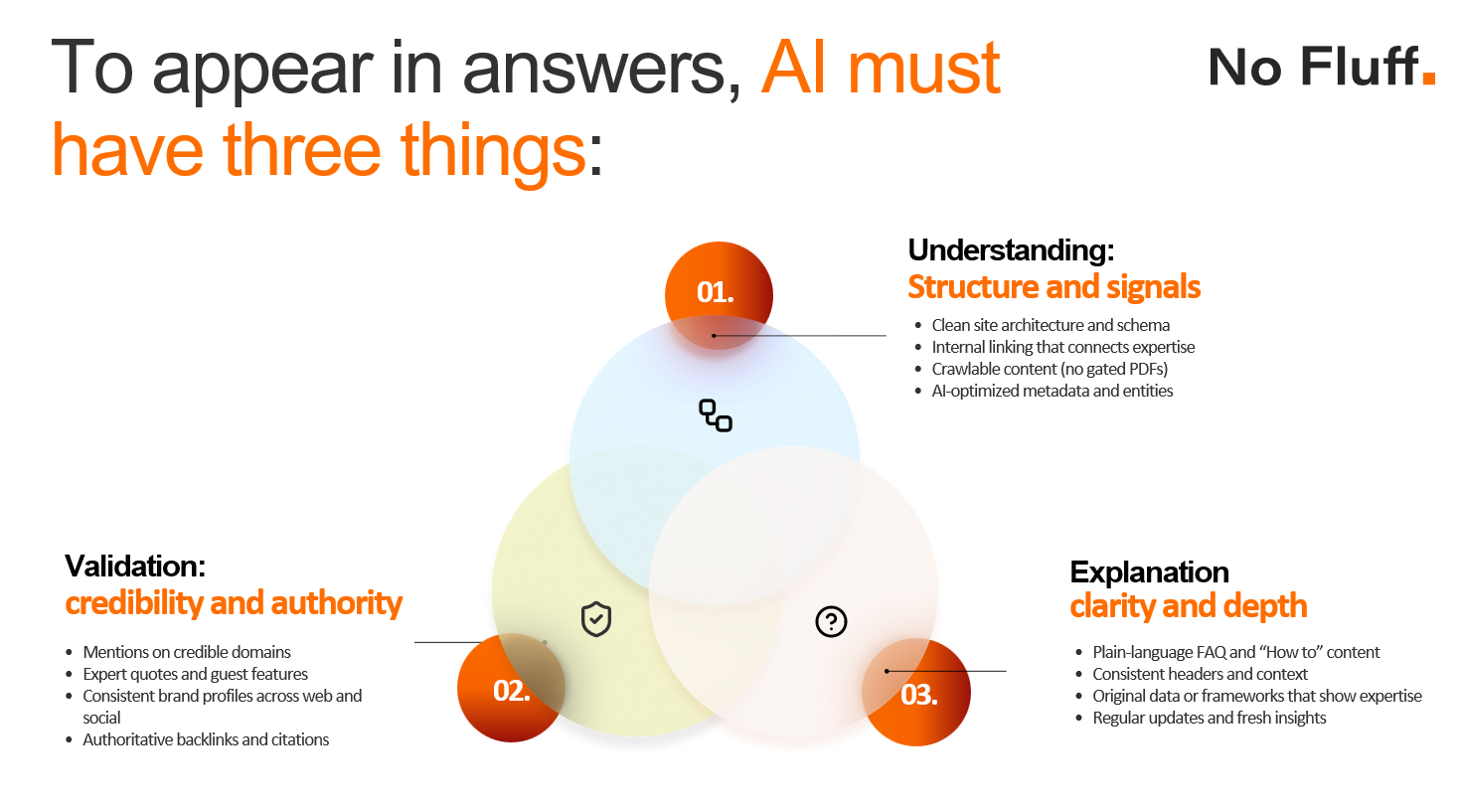
AI tools tend to recommend and not index. To earn a spot, your brand must appear credible and everywhere it exists online. Here’s what that means:
- Answer real customer questions on your site in factual language
- Earn mentions and backlinks from trusted publications.
- Join active discussions where buyers ask questions on platforms like YouTube, Reddit, and industry forums.
- Make your site easy for AI to read and understand
Every one of these matters. While technical website schema gives machines a map, your content gives them something to quote, and brand mentions make sure AI sees you as credible. Together, these signals can turn your brand from “just another link” into “the answer.”
A new metric for B2B marketing
The first companies that master AI visibility first will be the ones AI recommends. So instead of chasing metrics, start measuring citations and prompt-level presence.
These KPIs are a starting point:
- Are you showing up when buyers ask key questions inside ChatGPT or Perplexity?
- Are AI systems referencing your brand as a credible source?
- Which pages does AI pull when it explains your solution?
These metrics show whether AI recognizes your entity and expertise. They replace guesses with evidence, and that advantage compounds. Studying the questions buyers ask inside ChatGPT or Perplexity can reveal exactly what customers compare, doubt, and value. And that data can become a playbook for frontline teams.
In the end, visibility isn’t built by shouting louder. It’s built on measurable marketing that shows up everywhere AI looks and where buyers search.
The 90-Day Experiment
Search used to be the game of keywords. Now, it’s system credibility. But don’t just take our words for it; the idea only matters if it works. That is why we’re running a 90-day visibility sprint on our own site to validate this system.
We’ll track how No Fluff appears across ChatGPT, Gemini, Perplexity, and Google, and document which actions move the needle. We’ll also share all our findings publicly so B2B teams can learn from real data, not just speculation.
For weekly updates with the experiment results as we publish them, subscribe to the newsletter below.
Key Takeaways
- Search has shifted from links to answers.
- AI visibility is the new frontier of B2B revenue.
- Brands that become readable, citable, and credible first will own the next search era.